
Marketing Governance
The Structure That Makes Marketing Answerable
Most marketing organizations have the talent, the tools, and the intent. What breaks down is the decision layer underneath it all. Who owns what, who approves what, and who's accountable when AI accelerates everything and something goes wrong?
LEARN MORE
Where Governance Breaks Down in Most Organizations.
The breakdown rarely happens all at once. It accumulates quietly - across tool purchases nobody formally approved, campaigns that launched without a clear owner, AI outputs that went out without review, and KPIs that marketing, sales, and finance each measure differently.
By the time it surfaces in a board meeting or a CFO conversation, the CMO is defending a system they didn't design and can't fully explain. These are the most common governance gaps we see.
📍 Decision ownership is informal. Decisions get made by whoever is available, whoever is loudest, or whoever has been there longest. There's no documented framework for what requires consensus, what can be delegated, and what escalates to the CMO.
📍AI adoption has outpaced oversight. Teams are using tools nobody centrally approved, with data nobody sanctioned, producing outputs nobody reviewed. The CMO finds out when something goes wrong.
📍Accountability and authority are misaligned. The CMO is held accountable for outcomes they don't fully control - because the decision rights that would give them that control were never formally established.
📍 Institutional knowledge lives in people, not systems. When a key team member leaves, the operating model leaves with them. Onboarding new leaders means starting over rather than stepping into something that already works.

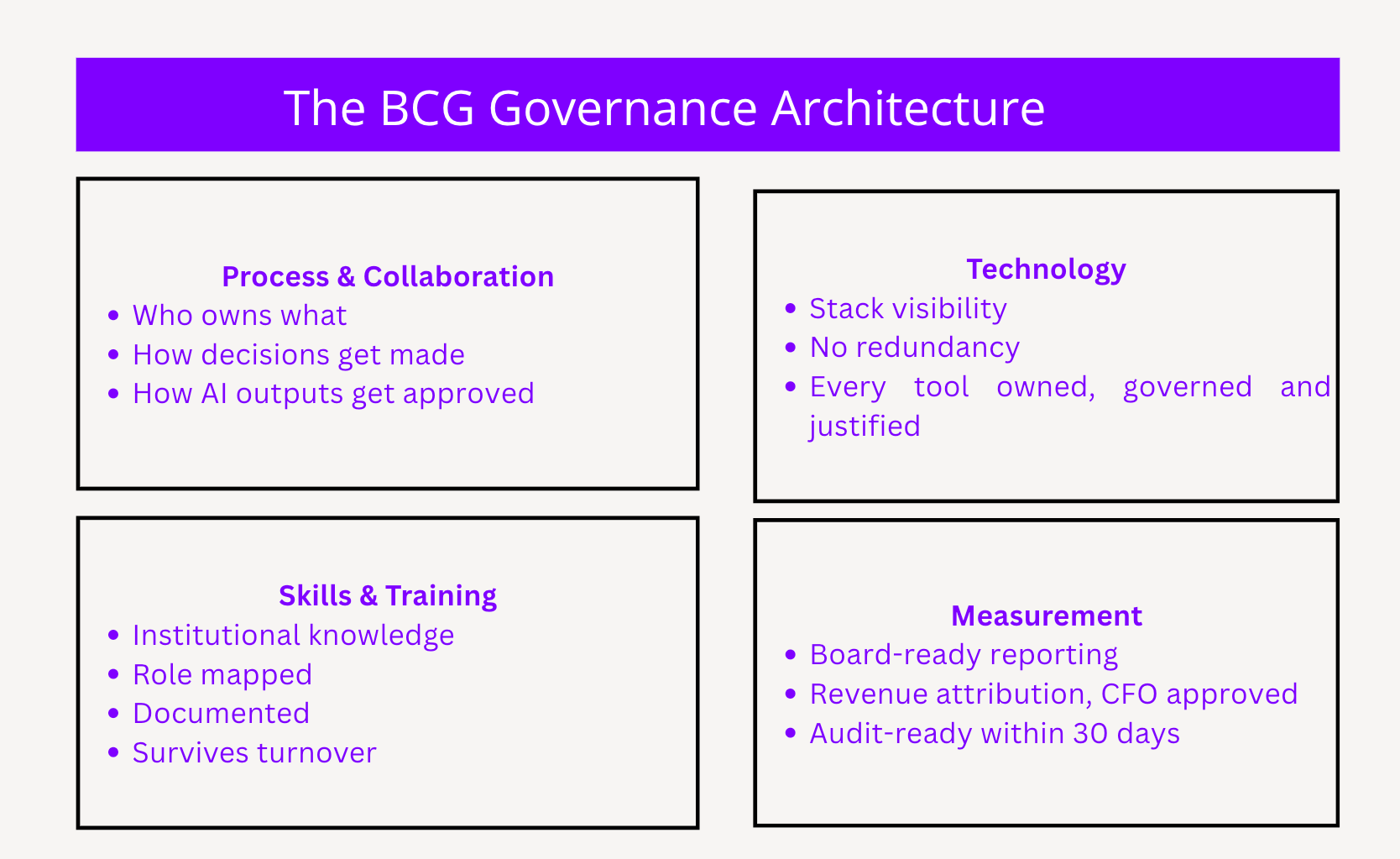
The BCG Governance Architecture
Built for Accenture clients in 2017. Now a board-level requirement.
The BCG Governance Architecture addresses marketing governance across four integrated layers - because fixing one without the others produces the same problems in a different place.
Process & Collaboration Who owns what. How decisions get made. How AI outputs get approved before they reach a customer, a board, or a regulator.
Technology Full stack visibility. No redundancy. Every tool owned, governed, and justified against a defined purpose — not a vendor relationship.
Skills & Training Institutional knowledge that is role-mapped, documented, and survives turnover. Teams that know how to operate the system, not just the tools inside it.
Measurement Board-ready reporting. Revenue attribution a CFO will accept. An audit trail that exists before anyone asks for it - not after.
REQUEST YOUR GOVERNANCE REVIEW →
THE PROCESS
How it Works
The Executive AI Governance Diagnostic produces
Decision Visibility
A clear map of which marketing decisions matter most, where they're actually being made, and where accountability and authority are misaligned.
Risk Awareness
A view of where AI is creating brand, data, or compliance exposure - before it surfaces in a board conversation or a CFO question.
A Shared Leadership Narrative
Language that marketing, finance, and the C-suite can all work from - so the conversation shifts from justifying spend to demonstrating architecture.
Ready to Build the structure that holds?
Start with a Governance Review
The decision to build governance clarity rarely feels urgent - until it is. The CMOs who are ready for that board conversation didn't wait until it was scheduled.
That conversation starts here.
